

Background. I’m a Data Science PhD student with Eric Schulz at Human-Centered AI. I have studied cognitive neuroscience (Heidelberg University & LMU Munich) and statistics & machine learning (LMU Munich & Tübingen University).
Research. I combine methods in statistics and machine learning to make either more efficient. My interests include Bayesian data analysis, hierarchical and latent variable modeling, as well as simulation-based inference.
Personal. Based in Munich & Berlin. Beside research, I enjoy music nerdism, fragrance hunting, and tea sipping.
Funding. My PhD is funded by the German Academic Scholarship Foundation and the Helmholtz Institute for Human-Centered AI.
Main Projects
Alex Kipnis, Marcel Binz, Eric Schulz (2026). metabeta - A fast neural model for Bayesian mixed-effects regression. Preprint. Code.
Classic mixed-effects regression is the gold standard tool for scientific analysis of clustered data. The Bayesian version allows incorporating prior knowledge and quantifies uncertainty, but is computationally slow and at times unstable. Metabeta is a neural model that approximates MCMC-based parameter estimation at a small fraction of computation time.
Alex Kipnis, Konstantinos Voudouris, Luca M. Schulze Buschoff, Eric Schulz (2025). metabench - A sparse benchmark of reasoning and knowledge in Large Language Models. ICLR 2025. Poster. Code.
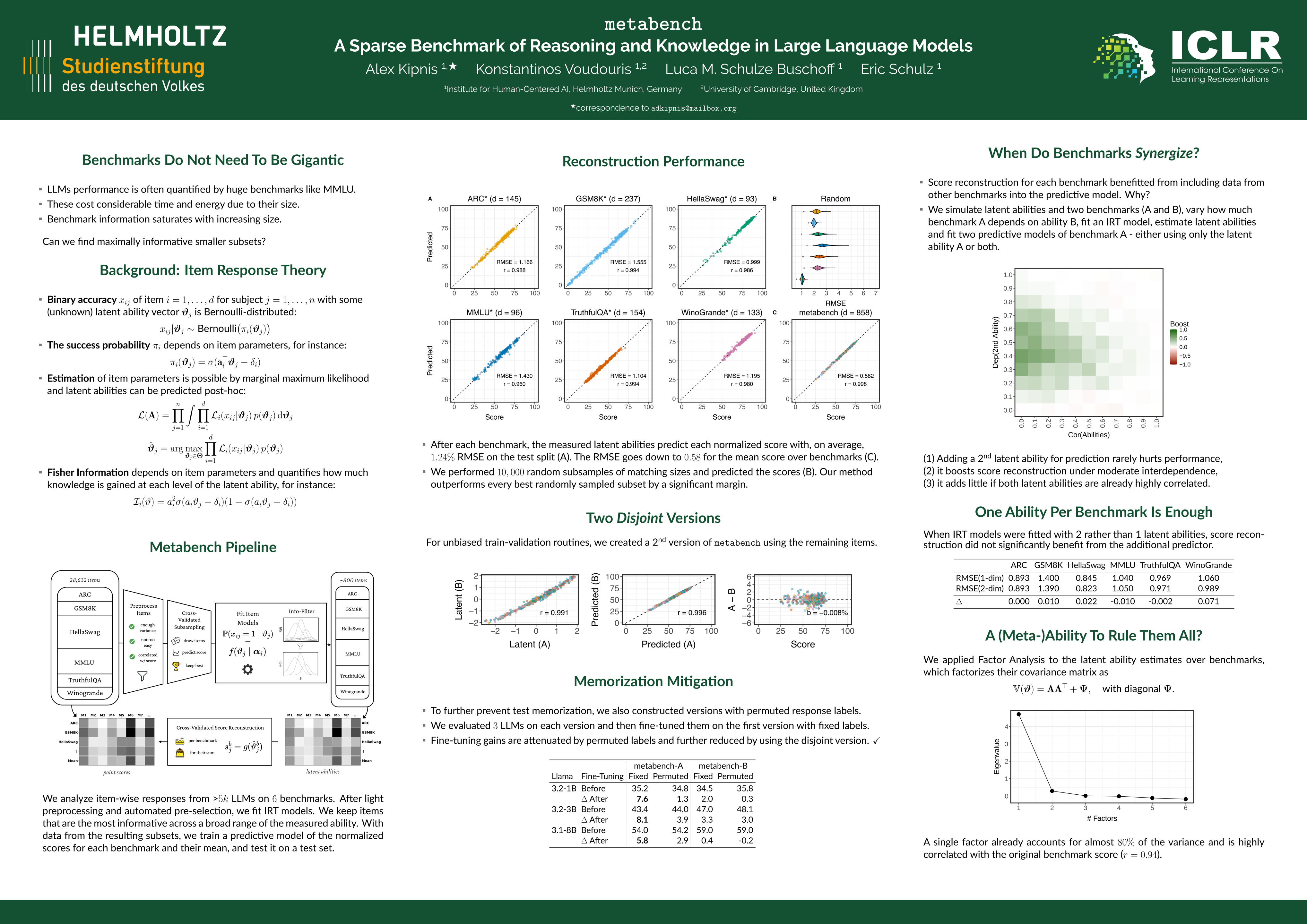
LLM-benchmarking is a notoriously resource intensive procedure, in which LLMs essentially have to solve thousands of multiple choice questions. Using data from ~5000 LLMs, we show that the information gain per question diminishes quickly. With the help of item-response modeling we compress 6 popular benchmarks to ~3% of the questions with next to no trade-off in predictive accuracy. We show synergy effects among single benchmarks and find a single latent ability governing all. Our benchmark is publically available on the Language Model Evaluation Harness.
Heiko Schütt, Alex Kipnis, Jörn Diedrichsen, Nikolaus Kriegeskorte (2023). Statistical inference on representational geometries. eLife. Code.
RSA is a popular multivariate method for neural data analysis. Based on faithful fMRI simulations from real data, we thoroughly compare established and new statistical approaches to RSA against the ground truth. A part of my MSc thesis went into this one, and this project jumpstarted my academic studies in statistics and machine learning.